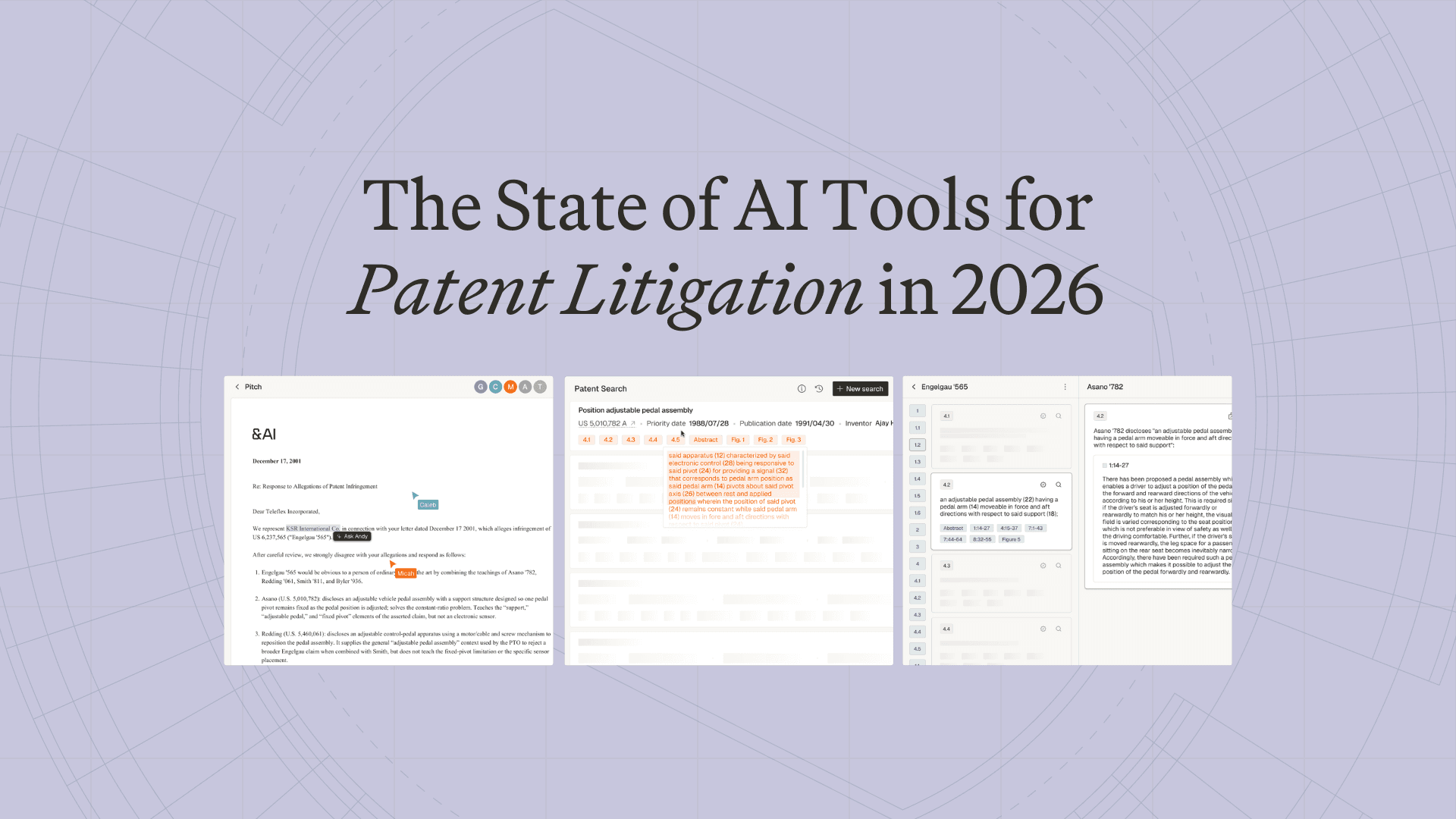
The State of AI for Post-Grant and Patent Litigation in 2026
February 1, 2026
 Caleb Harris
The past year has transformed how patent practitioners approach post-grant proceedings, district court litigation, portfolio monetization, and defense strategy. AI-powered platforms now handle tasks that once consumed weeks of associate time: generating claim charts for IPR petitions, mining prior art for PTAB challenges, building evidence of use, and identifying licensing opportunities in hours instead of days.
But not all patent AI is created equal. As adoption accelerates across Am Law 100 firms and Fortune 500 in-house teams alike, choosing the right platform has become a strategic decision with real implications for case outcomes, margins, and competitive positioning.
Most patent AI platforms weren't built for post-grant work. They started as drafting tools, prosecution assistants, or portfolio analytics platforms, then added litigation features later. That distinction matters when you're building an IPR petition, mounting a defense invalidity campaign, or identifying monetization targets across a portfolio.
We've analyzed the leading platforms in the patent AI space (&AI, Patlytics, Solve Intelligence, DeepIP, and IP Copilot) to help plaintiff and defense counsel understand what each brings to the table for invalidity contentions, non-infringement arguments, and everything in between.
What Post-Grant Practitioners Actually Need from AI
Post-grant and litigation practice demand AI purpose-built for what happens after a patent issues: IPR/PGR petition building, PTAB defense strategy, district court invalidity and infringement contentions, portfolio monetization analysis, licensing opportunity identification, and freedom to operate clearances. The best platforms don't just search faster. They understand how to build institution-worthy petitions, construct defensible claim charts, and surface monetization targets that justify enforcement investment.
&AI: Purpose-Built for Post-Grant and Litigation
&AI was built for post-grant proceedings and litigation from day one. Not as a feature addition, product extension, or "Charts" module added after a funding round.
While competitors started with patent drafting or portfolio analytics and later added litigation capabilities, &AI began with the questions that matter after a patent issues: Can this AI build IPR petitions that survive institution? Can it produce claim charts I'd file in court? Can it identify monetization opportunities across a portfolio?
Key Strengths:
IPR Petitions and PTAB Defense: &AI generates institution-ready claim charts with 83% evidence completeness in the first pass. Whether you're a petitioner building invalidity grounds or a patent owner mounting a defense, the platform maps element-by-element with citations optimized for PTAB standards, not repurposed prosecution formats.
Portfolio Monetization at Scale: Identify licensing targets, assess infringement exposure across product lines, and build evidence-of-use charts that justify enforcement investment. The platform surfaces monetization opportunities that would take weeks to find manually.
Prior Art Across All Sources: Real-time search spans patents, non-patent literature (research papers, standards, clinical trials), and product documentation including specifications, manuals, videos, and teardowns. This breadth is critical for building comprehensive IPR petitions and district court invalidity contentions.
Defense-Ready Workflows: Build non-infringement positions, construct validity arguments, and develop design-around strategies with AI that understands defense, not just plaintiff enforcement.
Business Development Intelligence: &AI includes a pitch feed with real-time litigation monitoring and ML-powered case recommendations, a capability not found in other platforms reviewed here.
Best For: Patent litigators and post-grant practitioners who need trial-ready work product. Whether you're building IPR petitions, mounting district court defense, pursuing portfolio monetization, or managing enforcement campaigns, &AI was built for the entire post-grant lifecycle. If litigation and post-grant proceedings are your primary workflow, this is the platform built for how you actually practice.
Patlytics: High-Level Patent Lifecycle
Patlytics covers the entire patent lifecycle (drafting, prosecution, portfolio management, and litigation) in a single platform. They started with patent intelligence and analytics, adding litigation features as the platform expanded.
Breadth comes at the cost of depth. The analysis is high-level, useful for portfolio triage and initial scoping, but may lack the granular, element-by-element precision that post-grant petitions and district court contentions demand. Teams may need significant manual refinement before work product is institution-ready or trial-ready.
Best For: In-house teams who need lifecycle visibility and can accept higher-level litigation analysis. The platform offers breadth across workflows; teams with intensive post-grant work may need additional tooling.
Solve Intelligence: Prosecution Platform, New to Litigation
Solve Intelligence built its reputation on patent drafting and prosecution before launching Charts, their litigation product, in late 2025. Like Patlytics, Solve is a broad platform that added litigation later, but their litigation product is newer. Charts launched recently and is still maturing. Teams focused on complex post-grant work may find the litigation features less refined than purpose-built alternatives.
Best For: Firms with prosecution as the primary use case who want to keep litigation in the same ecosystem. The litigation features may not yet match the depth of litigation-first platforms.
DeepIP: Microsoft Word Integration for Drafting
DeepIP embeds AI directly into Microsoft Word, focusing primarily on drafting and prosecution workflows. The platform is oriented toward drafting and prosecution rather than litigation. Teams needing dedicated invalidity analysis, infringement detection, or litigation-specific claim charting would likely need separate tooling for those workflows.
Best For: Patent prosecutors who want AI without leaving Word. Teams with litigation-heavy practices may need complementary solutions.
IP Copilot: Innovation Capture at the Source
IP Copilot operates at the front end of the patent lifecycle (innovation capture and disclosure) rather than litigation. It doesn't include invalidity analysis, claim charting, infringement detection, or prior art search for litigation purposes.
Best For: Corporate innovation teams focused on capturing inventions at scale. Teams with litigation-focused workflows would need separate tooling.
Making the Right Choice
The decision comes down to one question: is patent litigation your primary workflow, or a secondary use case?
Choose &AI if you need a tool that supports real trial-ready work product for patent litigation and post-grant proceedings. Whether you're building IPR petitions, pursuing portfolio monetization, or mounting defense invalidity positions, the post-grant-first architecture means every feature was designed for litigators rather than adapted from prosecution tools.
The Bottom Line
AI has moved from experiment to infrastructure for post-grant proceedings and patent litigation. The efficiency gains are real: claim charts in minutes instead of days, prior art surfaced in hours instead of weeks, monetization targets identified across entire portfolios.
But efficiency only matters if the output survives institution, wins at trial, or justifies enforcement economics. A specification that needs revision is an inconvenience. A petition that fails institution or a claim chart that falls apart under opposing counsel's scrutiny is a case-defining failure.
That's why platform origin matters. Tools that started in prosecution and pivoted to post-grant carry architectural assumptions that don't translate. The right partner is the one built for your workflow from the beginning, not the one that added your workflow after the last funding round.
For practitioners focused on IPR petitions, PTAB defense, portfolio monetization, and district court litigation, the platform you choose should reflect how you actually practice.
Request a demo of &AI to see institution-ready claim charts and prior art search built for post-grant and litigation workflows.
Frequently asked questions
What is the best AI platform for patent litigation and post-grant work?
The article identifies &AI as the platform built for patent litigation and post-grant proceedings from day one, rather than as a feature added after starting in drafting or portfolio analytics. It is positioned for practitioners who need trial-ready work product across the entire post-grant lifecycle, including IPR petitions, PTAB defense, portfolio monetization, and district court litigation. The central decision comes down to whether patent litigation is your primary workflow or a secondary use case.
What should post-grant practitioners look for in a patent AI platform?
Post-grant and litigation practice demand AI purpose-built for what happens after a patent issues, including IPR/PGR petition building, PTAB defense strategy, district court invalidity and infringement contentions, portfolio monetization analysis, licensing opportunity identification, and freedom-to-operate clearances. The best platforms don't just search faster; they understand how to build institution-worthy petitions, construct defensible claim charts, and surface monetization targets that justify enforcement investment. Platform origin matters because tools that started in prosecution carry architectural assumptions that don't translate.
How does &AI compare to Patlytics, Solve Intelligence, DeepIP, and IP Copilot?
According to the article, &AI was built for post-grant and litigation from day one, while the other platforms started elsewhere and added litigation later. Patlytics covers the entire patent lifecycle but offers higher-level analysis that may lack element-by-element precision; Solve Intelligence built its reputation on drafting and prosecution before launching its newer Charts litigation product in late 2025; DeepIP embeds AI in Microsoft Word focused on drafting and prosecution; and IP Copilot operates at innovation capture and does not include invalidity analysis, claim charting, infringement detection, or litigation prior art search.
How complete are &AI's claim charts for IPR petitions?
&AI generates institution-ready claim charts with 83% evidence completeness in the first pass. Whether you are a petitioner building invalidity grounds or a patent owner mounting a defense, the platform maps element-by-element with citations optimized for PTAB standards rather than repurposed prosecution formats.
What prior art sources does &AI search for invalidity contentions?
&AI's real-time prior art search spans patents, non-patent literature such as research papers, standards, and clinical trials, and product documentation including specifications, manuals, videos, and teardowns. This breadth is described as critical for building comprehensive IPR petitions and district court invalidity contentions.
Can &AI help identify patent licensing and monetization targets?
Yes. &AI lets practitioners identify licensing targets, assess infringement exposure across product lines, and build evidence-of-use charts that justify enforcement investment, surfacing monetization opportunities that would take weeks to find manually. It also includes business development intelligence in the form of a pitch feed with real-time litigation monitoring and ML-powered case recommendations, a capability the article says is not found in the other platforms reviewed.

Scale your
patent expertise
&AI is a platform for patent litigators to craft trial-ready work product—fast enough for pitches, strong enough for court.