US Patent No. 7,679,637 LLC v. Google LLC: Federal Circuit Affirms § 101 Dismissal
January 30, 2026
 Caleb Harris
On January 22, 2026, the Federal Circuit, in a precedential decision, affirmed a district court ruling that granted Google’s motion to dismiss US Patent No. 7,679,637 LLC’s infringement action on 35 U.S.C. § 101 grounds. US Patent No. 7,679,637 LLC v. Google LLC, No. 2024-1520 (Fed. Cir. Jan. 22, 2026). Chief Circuit Judge Moore authored the opinion, with Circuit Judge Hughes and Circuit Judge Stoll joining.
Key takeaways
- The Federal Circuit affirmed (precedential, Jan. 22, 2026) a Rule 12(b)(6) dismissal under 35 U.S.C. §101, holding the '637 web-conferencing "time-shifting" claims patent-ineligible.
- At Alice Step One, the claims were directed to the abstract idea of "playing back recorded content"—reciting what the system was arranged to allow without disclosing how the results were achieved (citing Beteiro; analogizing to Hawk Technology).
- At Alice Step Two, no inventive concept saved them; the time-scale modification component was disclosed as conventional in the specification.
- Takeaway: result-focused, functional software claims that don't disclose how results are achieved remain exposed to early §101 dismissal at the pleading stage.
The Case
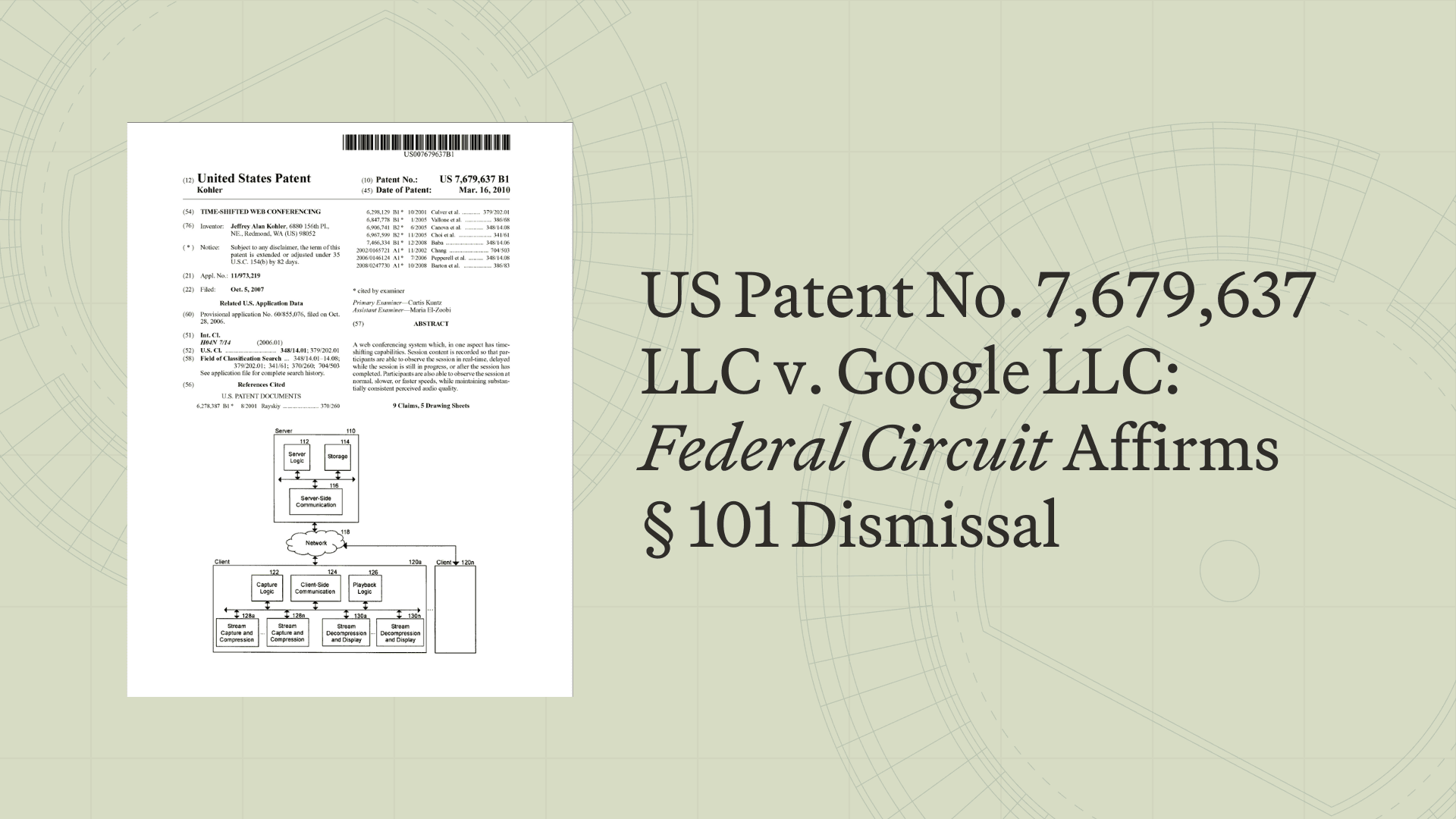
U.S. Patent No. 7,679,637 relates to web‑conferencing systems with “time‑shifting capabilities.” Participants can observe a session live, observe it delayed while still in progress, or observe it after completion. The ’637 patent also describes playing back the session at different rates while maintaining substantially consistent perceived audio quality.
The patent owner asserted claims 2–5 and 7–9, with claims 2 and 7 being treated as representative.

On appeal, regarding Alice Step One, Appellant argued that the district court erred in determining that the asserted claims were directed to the abstract idea of “playing back recorded content.” The Federal Circuit disagreed. Beginning with the claim language, the Court noted that the claims, particularly representative claim 2, only recited what the first and second client applications are arranged to allow and what the web conferencing system is able to achieve. Because the claims failed to disclose how the client applications achieved these results, the Federal Circuit thus affirmed the district court, citing Beteiro, LLC v. DraftKings Inc., 104 F.4th 1350, 1356 (Fed. Cir. 2024).
Appellant further argued that the claims were not result-oriented because they recite that the first and second client applications enable the manipulation of multiple data streams. But the Federal Circuit, again, disagreed. Turning to the written description, the Circuit noted that the disclosure did not suggest that the use of these client applications and multiple data streams solved a technical problem.
Ultimately, the Federal Circuit analogized the asserted claims to those at issue in Hawk Technology Systems, where it found claims patent ineligible for reciting subject matter at “such a level of result-oriented generality that those claims amount[ed] to a mere implementation of an abstract idea.” Hawk Tech. Sys., LLC v. Castle Retail, LLC, 60 F.4th 1349, 1358 (Fed. Cir. 2023) (quoting Koninklijke KPN N.V. v. Gemalto M2M GmbH, 942 F.3d 1143, 1152 (Fed. Cir. 2019)).
Regarding Alice Step Two, Appellant argued that the district court erred in its application by overlooking the following inventive concepts: (1) a two client application system allowing for the manipulation of multiple data streams and (2) a time-scale modification component. The Federal Circuit disagreed, noting that, to support its Step Two positions, Appellant largely repeated its Step One arguments and that the time-scale modification component could not constitute an inventive concept because the specification disclosed it was conventional.**
Takeaway
In software cases, it appears that claims reciting result-focused, functional language, without disclosing how the results are achieved, remain exposed to potential early 12(b)(6) dismissal on § 101 grounds.
**The Federal Circuit also rejected Appellant’s procedural arguments that dismissal at the Rule 12(b)(6) stage was premature and that leave to amend should have been granted. Those arguments are not discussed in this summary.
Frequently asked questions
What did the Federal Circuit decide in US Patent No. 7,679,637 LLC v. Google LLC?
On January 22, 2026, the Federal Circuit issued a precedential decision affirming a district court ruling that granted Google's motion to dismiss US Patent No. 7,679,637 LLC's infringement action on 35 U.S.C. § 101 grounds. The case is US Patent No. 7,679,637 LLC v. Google LLC, No. 2024-1520 (Fed. Cir. Jan. 22, 2026). Chief Circuit Judge Moore authored the opinion, joined by Circuit Judges Hughes and Stoll.
What did U.S. Patent No. 7,679,637 cover?
U.S. Patent No. 7,679,637 relates to web-conferencing systems with "time-shifting capabilities," allowing participants to observe a session live, observe it delayed while still in progress, or observe it after completion. The patent also describes playing back the session at different rates while maintaining substantially consistent perceived audio quality. The patent owner asserted claims 2–5 and 7–9, with claims 2 and 7 treated as representative.
How did the court apply Alice Step One to the asserted claims?
The Federal Circuit agreed that the asserted claims were directed to the abstract idea of "playing back recorded content." Beginning with the claim language, the court noted that representative claim 2 only recited what the client applications are arranged to allow and what the system is able to achieve, without disclosing how the client applications achieved those results. The court also found that the written description did not suggest the client applications and multiple data streams solved a technical problem, analogizing the claims to those in Hawk Technology Systems.
Why did the inventive concept arguments fail at Alice Step Two?
At Alice Step Two, the appellant argued the district court overlooked two inventive concepts: a two-client-application system allowing manipulation of multiple data streams, and a time-scale modification component. The Federal Circuit disagreed, noting that the appellant largely repeated its Step One arguments to support its Step Two positions. The court further found that the time-scale modification component could not be an inventive concept because the specification disclosed that it was conventional.
What is the takeaway for software patents from this § 101 decision?
In software cases, it appears that claims reciting result-focused, functional language without disclosing how the results are achieved remain exposed to potential early Rule 12(b)(6) dismissal on § 101 grounds. The article notes the Federal Circuit also rejected the appellant's procedural arguments that dismissal at the 12(b)(6) stage was premature and that leave to amend should have been granted.

Scale your
patent expertise
&AI is a platform for patent litigators to craft trial-ready work product—fast enough for pitches, strong enough for court.