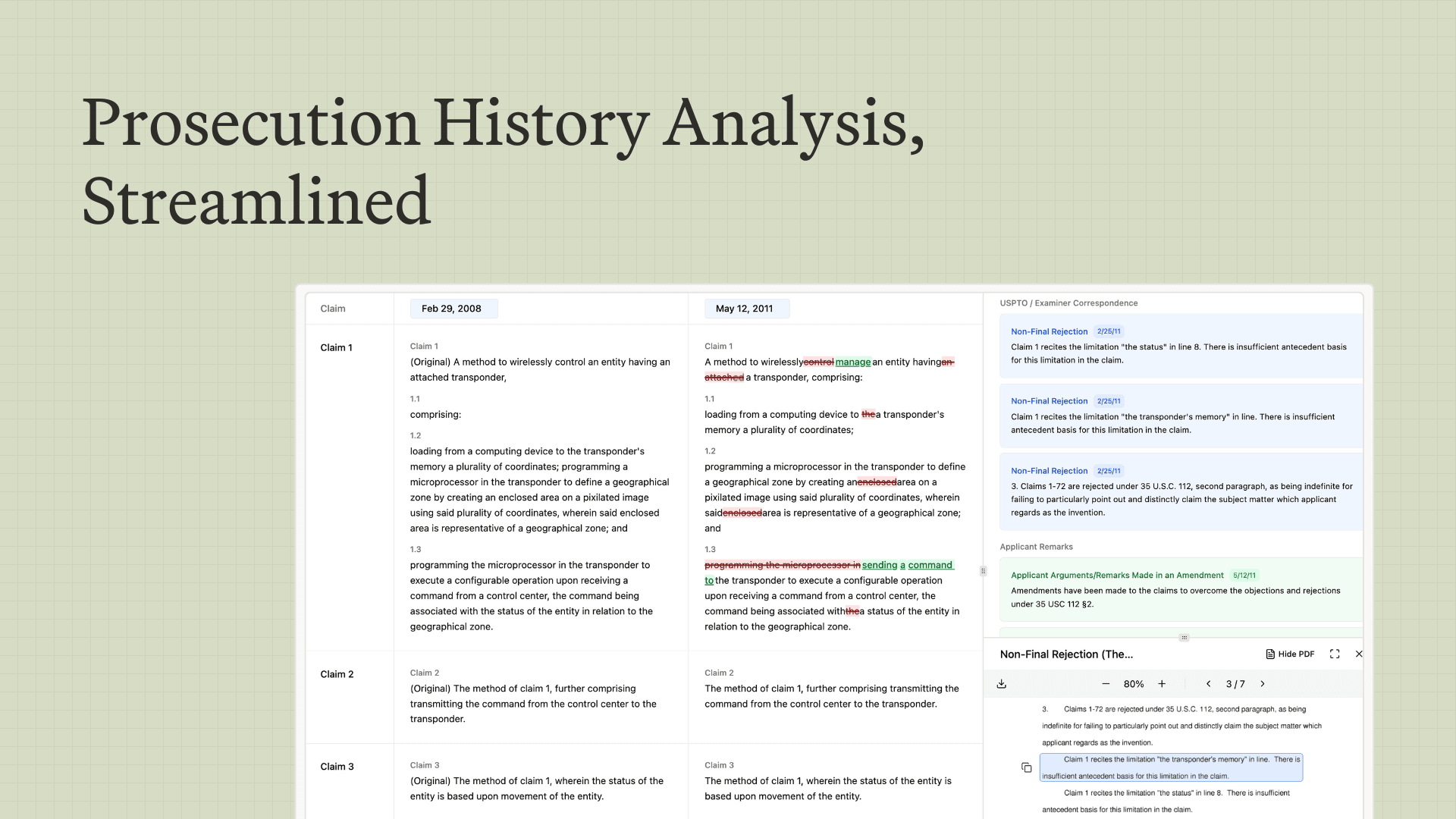

Prosecution history analysis requires hours of tedious change tracking and cross-document comparison before any real analysis begins. &AI compresses that work into seconds. Every claim version redlined, every change linked to the document that triggered it.
Now, patent litigators can spend their time on the judgment, not the document management.
Why Prosecution History Analysis Takes So Long
For a single patent with moderate prosecution, prosecution history analysis can take hours. For multi-patent cases with extensive families, this can take weeks.
Two things make this process particularly time-consuming:
- Matching examiner actions to applicant responses. An office action might reject claims 1-5 on one ground and claims 6-12 on another. The applicant's response might amend some claims, argue others, and cancel a few.
- Extracting and comparing claim text across versions. Spotting these differences across multiple amendment rounds requires meticulous comparison.
How &AI Transforms Prosecution History Analysis
&AI automates the assembly, surfacing all of the relevant information in minutes. The judgment about what prosecution history means for a case stays with the practitioner.

Complete File Wrapper Downloaded
When a target patent document is processed, &AI automatically pulls the entire file wrapper. Every office action, amendment, response, and notice of allowance, organized in a timeline with examiner actions automatically paired to their corresponding applicant responses.
Every Claim Version, Redlined
&AI builds a redlined comparison of every claim version across all amendments. Additions in green, deletions in red. Walk through the full sequence or compare any two specific versions side by side.
See What Changed and Why
Each change links back to the document that triggered it. Hover over an amended limitation and see which office action rejection prompted that change, or which argument the applicant made in their remarks.
Document Summaries
&AI generates summaries of key prosecution documents. Understand the prosecution story in minutes, then drill into specific claim diffs where it matters.
Analysis Across the Family
The analysis extends to patent family members. Trace how claims evolved not just within a single patent's prosecution, but across the family.
Where This Matters Most
Prosecution History Estoppel Analysis
Prosecution history estoppel prevents a patentee from using the doctrine of equivalents to reclaim subject matter disclaimed or surrendered during prosecution. Understanding exactly what was argued and what was surrendered requires a clear view of how claims changed and why.
Claim Construction
Prosecution history is often used as evidence for determining a claim term's meaning under the Phillips standard. &AI's claim construction feature pulls evidence from prosecution history automatically, connecting the two workflows.
Invalidity Analysis
Prosecution history shows what ground has already been covered and how the applicant positioned their claims relative to the prior art.
Portfolio Assessment
For large portfolios, prosecution history analysis is often the first step in assessing patent strength. When you can review claim evolution in minutes instead of hours per patent, portfolio-level analysis becomes practical.
From Assembly to Analysis
&AI surfaces the important information, so that judgment isn't buried under document management. Every claim version, redlined and annotated. Every change linked to its source. Across the patent family.
Now, prosecution history analysis is ready for your expertise in minutes, not weeks.
Book a demo to see &AI's prosecution history analysis tools in action.
Frequently asked questions
How does &AI speed up prosecution history analysis?
&AI automates the assembly of prosecution history, surfacing all of the relevant information in minutes instead of the hours or weeks it takes manually. When a target patent is processed, &AI automatically pulls the entire file wrapper, organizes every office action, amendment, response, and notice of allowance into a timeline, and pairs each examiner action with its corresponding applicant response. The judgment about what the prosecution history means for a case stays with the practitioner.
Why does manual prosecution history analysis take so long?
Two things make manual prosecution history analysis particularly time-consuming. First, matching examiner actions to applicant responses is complex because an office action might reject different claims on different grounds while the applicant amends some claims, argues others, and cancels a few. Second, extracting and comparing claim text across multiple amendment rounds requires meticulous side-by-side comparison.
Can &AI show how patent claims changed during prosecution?
Yes. &AI builds a redlined comparison of every claim version across all amendments, showing additions in green and deletions in red. You can walk through the full sequence of amendments or compare any two specific claim versions side by side, and each change links back to the document that triggered it, such as the office action rejection or applicant argument behind an amended limitation.
How does &AI help with prosecution history estoppel analysis?
Prosecution history estoppel prevents a patentee from using the doctrine of equivalents to reclaim subject matter disclaimed or surrendered during prosecution, so understanding exactly what was argued and surrendered requires a clear view of how claims changed and why. &AI provides that view by redlining every claim version and linking each change to its source document, making it easier to identify what was surrendered. The analysis also extends across patent family members.
Does &AI connect prosecution history to claim construction?
Yes. Prosecution history is often used as evidence for determining a claim term's meaning under the Phillips standard, and &AI's claim construction feature pulls evidence from prosecution history automatically, connecting the two workflows. &AI also generates summaries of key prosecution documents so practitioners can understand the prosecution story quickly before drilling into specific claim diffs.

Scale your
patent expertise
&AI is a platform for patent litigators to craft trial-ready work product—fast enough for pitches, strong enough for court.