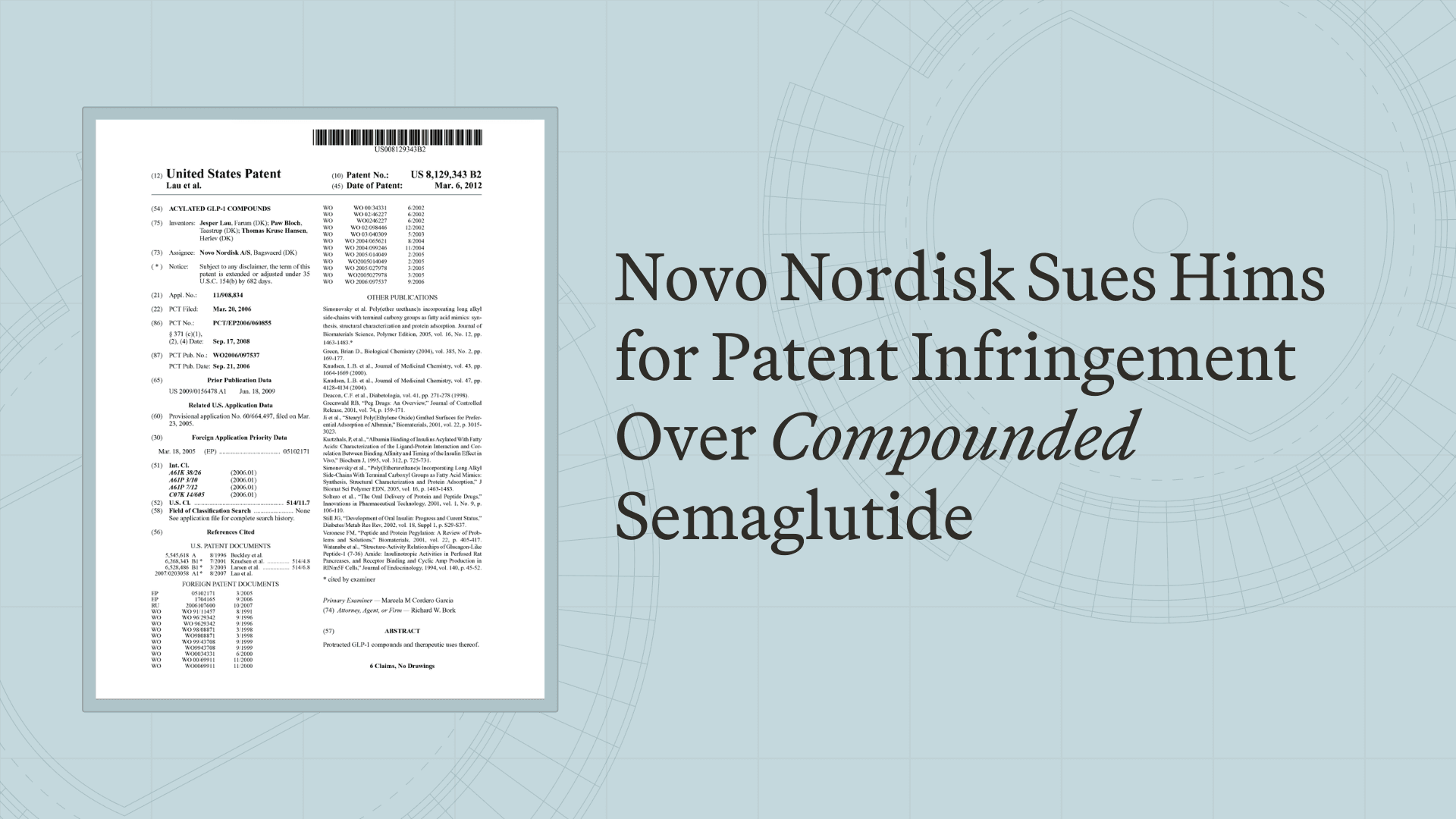
Novo Nordisk Targets Hims & Hers’ Compounded Semaglutide Offerings in Patent Lawsuit
February 18, 2026
 Caleb Harris
On February 9, 2026, Novo Nordisk A/S and Novo Nordisk Inc. filed a complaint for patent infringement in the United States District Court for the District of Delaware against Hims & Hers Health, Inc. and its subsidiary Hims, Inc.
Key takeaways
- Novo Nordisk sued Hims & Hers in Delaware (Feb. 9, 2026), asserting U.S. Patent 8,129,343, which claims the semaglutide compound itself—the API in Ozempic, Wegovy, and Rybelsus.
- The suit tests whether inducement (§271(b)) can reach a platform that coordinates API suppliers, compounding pharmacies, and prescribers without making the drug, alongside direct-infringement claims under §271(a).
- Novo alleges willful infringement—citing the patent's Orange Book listing, Hims CEO statements, and a pre-suit demand letter—and seeks enhanced damages under §284.
- A central open question: whether FDCA compounding exemptions (§§503A/503B) shield compounders from patent infringement; Novo argues they do not override patent rights.
- The filing coincided with FDA enforcement action and a DOJ referral, and Hims withdrew the product days before suit.
Background
The asserted patent is U.S. Patent No. 8,129,343, which claims the semaglutide compound itself. Semaglutide, whose structure is shown below, is the active pharmaceutical ingredient in Novo Nordisk’s Ozempic®, Wegovy®, and Rybelsus®.

According to the complaint, Hims does not compound the drugs itself but coordinates with API suppliers, compounding pharmacies, and prescribers.
Events moved quickly in the days surrounding the filing. On February 5, Hims announced a compounded oral semaglutide pill starting at $49 per month, undercutting Novo's branded Wegovy pill at a reported self-pay price of $149. Novo responded the same day, publicly characterizing the product as "illegal mass compounding that poses a significant risk to patient safety." On February 6, the FDA announced it would take action against companies mass-marketing unapproved compounded GLP-1 products, and HHS General Counsel stated publicly that the department had referred Hims to the DOJ for potential FDCA violations. By February 7, Hims had announced it would stop offering access. Novo filed the patent suit two days later, on February 9.
In public statements following the filing, Hims called the lawsuit "a blatant attack by a Danish company on millions of Americans who rely on compounded medications for access to personalized care." Novo challenged the efficacy of Hims's oral formulation and cited its own testing of compounded semaglutide products, reporting impurity levels of up to 86% in injectable formulations and up to 75% in oral formulations. Hims's stock declined following the convergence of the lawsuit, the FDA enforcement actions, and the product withdrawal.
Analysis
Direct Infringement and Inducement
The complaint alleges infringement under both 35 U.S.C. § 271(a) and § 271(b). The direct infringement claim asserts that Hims's compounded products contain semaglutide and fall within at least claim 1 of the '343 patent.
The inducement theory targets Hims's role as a platform. The complaint alleges that Hims orchestrated infringement by coordinating with API suppliers, compounding pharmacies, prescribers, and patients, and cites a YouTube video titled "How to Take Compounded GLP-1 Injections" as evidence of active encouragement. By pursuing Hims as the centralized defendant rather than individual compounding facilities, Novo is testing whether the inducement framework can reach the entity that coordinates the supply chain without manufacturing the product itself.
Willfulness
The complaint alleges willful infringement based on both pre-suit and post-suit knowledge of the '343 patent. The evidence cited includes the patent's listing in the FDA Orange Book, public statements by Hims's CEO on an August 2024 investor call discussing GLP-1 patent cliffs and acknowledging that semaglutide was not going off patent, and a formal demand letter sent by Novo Nordisk on February 8, 2026, one day before filing. Novo seeks enhanced damages under 35 U.S.C. § 284, though willfulness determinations are highly fact-specific and remain at the court's discretion post-Halo.
Compounding Exemptions vs. Patent Rights
Congress created limited exemptions allowing pharmacies to compound certain drugs under FDCA §§ 503A and 503B, but those provisions do not explicitly address whether compounding exemptions shield compounders from patent infringement claims. Novo's complaint takes the position that those regulatory permissions do not override patent rights or authorize replication of a patented molecule at commercial scale. The FDA's enforcement actions in the same week, which targeted mass-marketed compounded GLP-1 products and warned of potential seizure and injunction for non-compliance, suggest the regulatory framework is tightening around compounded semaglutide products.
Frequently asked questions
What is the Novo Nordisk v. Hims & Hers patent lawsuit about?
On February 9, 2026, Novo Nordisk A/S and Novo Nordisk Inc. filed a patent infringement complaint in the U.S. District Court for the District of Delaware against Hims & Hers Health, Inc. and its subsidiary Hims, Inc. The asserted patent is U.S. Patent No. 8,129,343, which claims the semaglutide compound itself, the active ingredient in Novo Nordisk's Ozempic, Wegovy, and Rybelsus.
What patent infringement claims did Novo Nordisk assert against Hims?
The complaint alleges infringement under both 35 U.S.C. § 271(a) for direct infringement and § 271(b) for inducement. The direct claim asserts that Hims's compounded products contain semaglutide and fall within at least claim 1 of the '343 patent, while the inducement theory targets Hims's role in coordinating with API suppliers, compounding pharmacies, prescribers, and patients, citing a YouTube video titled "How to Take Compounded GLP-1 Injections" as evidence of active encouragement.
What is the willful infringement allegation in the Novo Nordisk complaint?
Novo Nordisk alleges willful infringement based on both pre-suit and post-suit knowledge of the '343 patent. The cited evidence includes the patent's listing in the FDA Orange Book, August 2024 investor-call statements by Hims's CEO acknowledging that semaglutide was not going off patent, and a formal demand letter Novo sent on February 8, 2026, one day before filing. Novo seeks enhanced damages under 35 U.S.C. § 284, though willfulness determinations remain highly fact-specific and at the court's discretion post-Halo.
Do compounding exemptions protect against patent infringement claims?
According to the article, Congress created limited exemptions allowing pharmacies to compound certain drugs under FDCA §§ 503A and 503B, but those provisions do not explicitly address whether the exemptions shield compounders from patent infringement claims. Novo Nordisk's complaint takes the position that regulatory permissions do not override patent rights or authorize replication of a patented molecule at commercial scale.
Why did Novo Nordisk sue Hims rather than the compounding pharmacies?
By pursuing Hims as the centralized defendant rather than individual compounding facilities, Novo Nordisk is testing whether the inducement framework can reach the entity that coordinates the supply chain without manufacturing the product itself. The complaint notes that Hims does not compound the drugs itself but coordinates with API suppliers, compounding pharmacies, and prescribers.

Scale your
patent expertise
&AI is a platform for patent litigators to craft trial-ready work product—fast enough for pitches, strong enough for court.