Zip Top v. SC Johnson & Son: Another Familiar Claim Construction Reminder from the Federal Circuit
January 21, 2026
 Caleb Harris
Closing out its 2025 docket, the Federal Circuit, in a nonprecedential decision, affirmed a grant of summary judgment of noninfringement the United States District Court for the Northern District of Illinois’s in Zip Top, Inc. v. SC Johnson & Son Incorporated, No. 2024-1661 (Fed. Cir. Dec. 30, 2025). District Judge John H. Chun, sitting by designation, authored the opinion, with Chief Judge Moore and Circuit Judge Taranto joining.
The Case
Zip Top sued SC Johnson, alleging that SC Johnson’s Ziploc® Endurables™ reusable silicone products infringed U.S. Patent No. 11,383,890, which relates to a silicone molding process for making a container having zipper members (57, 58) tapered at a flexible spout (53).

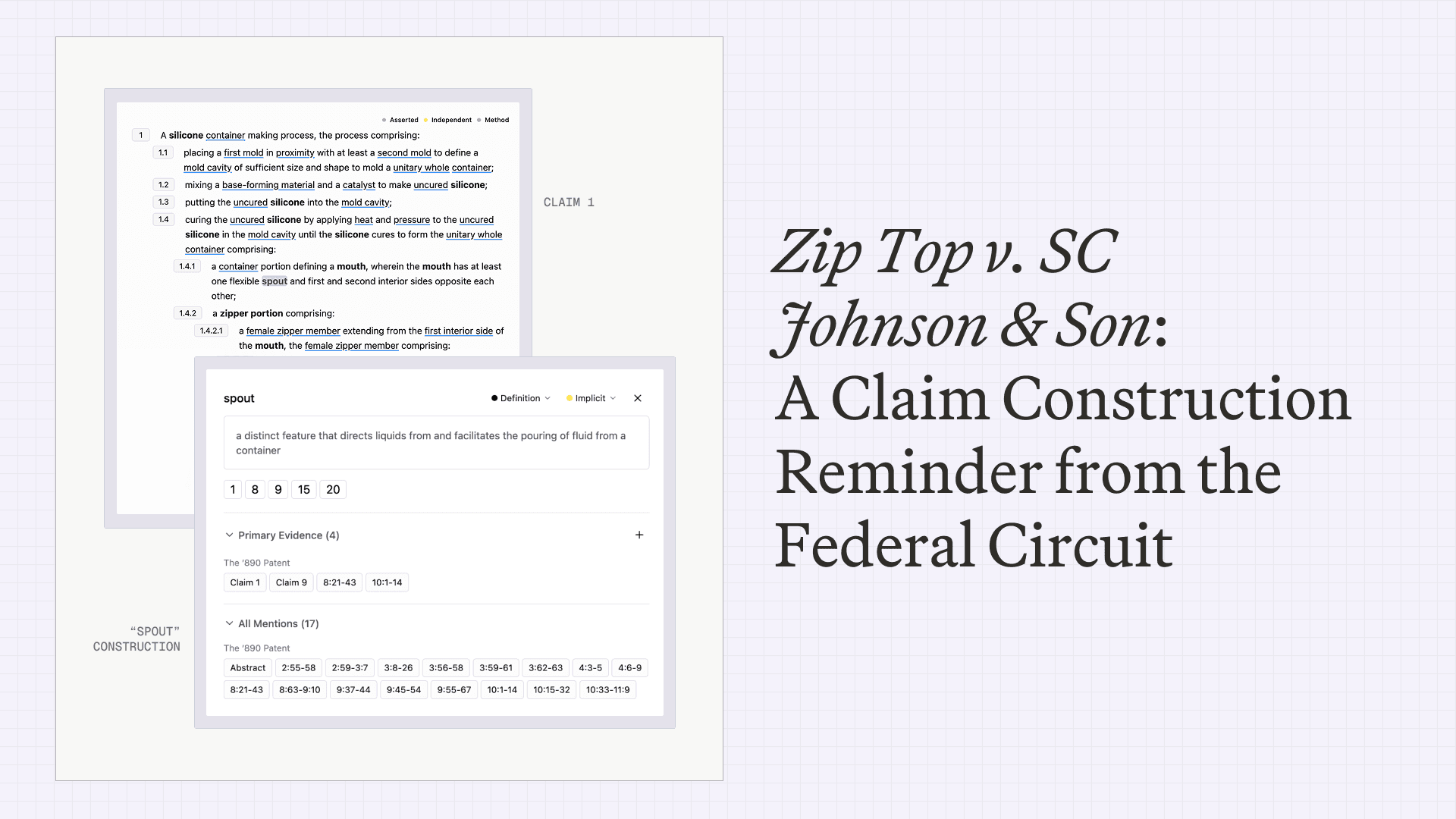
The infringement dispute turned on the construction of the term “spout” recited in claims 1 and 9 of the ’890 patent.

Although the parties agreed that the “spout” element should be construed as a “distinct feature that directs liquids from and facilitates the pouring of fluid from a container,” Zip Top argued that this construction should also include certain “cross over” zipper embodiments, as shown in Figs. 5B–5C.
The district court rejected Zip Top’s position, concluding that the cross over zipper members depicted in those figures are adjacent to—rather than part of—the spout itself. On that basis, the court construed the spout as a separate structural feature and granted summary judgment of noninfringement for SC Johnson, finding no genuine dispute that the accused products lacked the claimed spout limitation.
On appeal, Zip Top argued, inter alia, that the district court’s construction improperly imposed a negative limitation by excluding the cross over zipper structures from the scope of the “spout.”
The Federal Circuit disagreed. Focusing largely on claim language, the Circuit noted that claims 1 and 9 of the ’890 patent recite “zipper members” and the “spout” as distinct elements. In view of this recitation, the Circuit found no support in the claims for Zip Top’s attempt to broaden the scope of the term “spout” based on the “cross over” zipper embodiments shown in Figs. 5B–5C, affirming the district court’s construction.
Where Zip Top Went Wrong
The decision reinforces a familiar, but frequently contested principle of claim construction: where the claims recite features as separate elements, patent owners face significant headwinds in expanding the scope of one element to encompass another based on preferred embodiments not reflected in the claims.
Here, the Federal Circuit gave dispositive weight to the claims themselves, declining to import structural relationships shown in Figs. 5B–5C. The opinion underscores the continued risk of embodiment-driven arguments that seek to broaden claim scope where the claims (and specification) draw clear distinctions between components.
Claim Construction Deserves Early Attention
Cases like Zip Top, Inc. illustrate how small shifts in claim construction can be outcome-determinative. When evaluating infringement or validity positions, it is often useful to test how alternative constructions affect claim scope before committing to a theory.
&AI allows patent litigators to apply and compare multiple constructions of a claim limitation, making it easier to assess the downstream impact of competing interpretations.

Our claim construction tool helps you generate constructions, see supporting evidence from the intrinsic record, flag when your position lacks strong specification support, and export court-ready Markman charts.
Book a demo to try &AI for free and see how constructions change your case.
Frequently asked questions
What did the Federal Circuit decide in Zip Top v. SC Johnson?
The Federal Circuit, in a nonprecedential decision issued December 30, 2025, affirmed the Northern District of Illinois's grant of summary judgment of noninfringement in favor of SC Johnson. The opinion was authored by District Judge John H. Chun, sitting by designation, with Chief Judge Moore and Circuit Judge Taranto joining.
What was the claim construction dispute in Zip Top v. SC Johnson about?
The dispute turned on the construction of the term "spout" recited in claims 1 and 9 of U.S. Patent No. 11,383,890. Both parties agreed "spout" meant a "distinct feature that directs liquids from and facilitates the pouring of fluid from a container," but Zip Top argued the construction should also include certain "cross over" zipper embodiments shown in Figs. 5B–5C.
Why did Zip Top lose its infringement claim against SC Johnson?
The district court concluded that the cross over zipper members in Figs. 5B–5C are adjacent to, rather than part of, the spout itself, construing the spout as a separate structural feature. It then granted summary judgment of noninfringement, finding no genuine dispute that the accused Ziploc Endurables products lacked the claimed spout limitation, and the Federal Circuit affirmed.
Why did the Federal Circuit reject Zip Top's broader construction of "spout"?
The Federal Circuit focused largely on the claim language, noting that claims 1 and 9 recite "zipper members" and the "spout" as distinct elements. Given that recitation, the court found no support in the claims for broadening "spout" based on the cross over zipper embodiments in Figs. 5B–5C, declining to import structural relationships from those figures.
What claim construction lesson does Zip Top v. SC Johnson reinforce?
The decision reinforces that where claims recite features as separate elements, patent owners face significant headwinds in expanding the scope of one element to encompass another based on preferred embodiments not reflected in the claims. The article notes the continued risk of embodiment-driven arguments that seek to broaden claim scope where the claims and specification draw clear distinctions between components.

Scale your
patent expertise
&AI is a platform for patent litigators to craft trial-ready work product—fast enough for pitches, strong enough for court.