What is the best AI prior art search tool for patent litigators in 2026?
For a litigator, the best AI prior art search tool searches the widest body of art (patents, non-patent literature, and real-world products) and works agentically, running the same multi-tool, multi-pass process a senior searcher would. It returns traceable citations for every result and connects what it finds to an invalidity position and a claim chart. &AI's prior art search agent is built for that full path.
Prior art search used to be a specialist task you outsourced, then waited days to get back. AI has collapsed that timeline. It has also raised the bar on what counts as good work. In litigation, a result you can't trace to a dated, authenticated source isn't usable at all, and that is the standard this guide is written to.
What makes an AI prior art search tool "litigation-grade"?
Most patent AI tools can hand you a list of similar patents. In litigation, that barely registers. What actually matters is narrower.
- Breadth of corpus. Patents are the easy part. The references that invalidate often sit in non-patent literature (journal articles, standards, manuals, theses, videos) or in products that were on sale or in public use. A tool limited to patent databases will miss the art that wins.
- Verifiable, dated citations. Every result needs a source you can authenticate and date, because prior art only counts if you can prove it qualifies as a printed publication, public use, or on-sale event. A black-box "relevance score" with no source behind it is a liability.
- Semantic and claim-aware search. The strongest tools search by the concept inside a claim limitation rather than by keyword, and they let you search against a specific element.
- Agentic, multi-pass search. Plenty of "AI search" fires a single query, ranks the results, and stops. A litigation-grade tool behaves like a senior searcher instead, chaining semantic and boolean search, citation-graph traversal, prosecution-history analysis, and web strategies across several passes. It also shows its work as it goes, so you can audit, redirect, or hand off the session.
- A path to invalidity, not just a list. Results should flow into a §102 (anticipation) or §103 (obviousness) analysis and a claim chart. Anything short of that leaves you stuck at step one.
- Defensibility and repeatability. When your search ends up in an IPR petition or an expert report, a documented, repeatable method is what holds up.
AI prior art search vs. traditional search firms: which is better?
AI wins on speed, cost, and breadth for the first pass and for any search you expect to iterate. A traditional firm still earns its place on the highest-stakes searches, where a second human expert and a signed, defensible work product justify the time and expense. By 2026, most litigation teams run both: AI for the volume, a firm for the one search that has to be right.
Where AI prior art search wins
Speed is the obvious advantage. AI returns results in minutes or hours instead of the days or weeks a firm engagement takes, and the marginal cost of running another search is close to nothing, against the hundreds or thousands a firm bills per pass. For first-pass, iterative, high-volume, or budget-sensitive searches, that combination is hard to beat, and the output holds up as long as the citations are sourced and the method is documented.
The best AI prior art search tools for litigators in 2026
&AI — agentic search built for litigation and invalidity
&AI's prior art search agent runs the multi-pass workflow a senior searcher would, but compresses it into one session and shows its work along the way. Instead of firing a single query and ranking what comes back, it reaches for the same toolkit a human expert would: semantic and boolean search across patent databases, citation-graph traversal, prosecution-history analysis, web-based strategies, and more. Its reach extends to global patents and applications, non-patent literature, clinical trials, system art, and infringing products.
Every step stays visible. As it runs, the &AI search agent surfaces which tool it called, which query it ran, and which references it kept or discarded and why. You can read the trace, step in to redirect it, or hand the session to a colleague who picks up where you left off. For a litigator, that is what separates a search you can put your name on from one you can't.
Because those results feed straight into invalidity analysis and trial-ready claim charts, &AI suits teams whose real job is turning a search into a §102 or §103 position they can file. It also makes a strong case for bringing prior art search in-house rather than sending it out.
IPRally — semantic, knowledge-graph patent search
IPRally built its reputation on graph-based semantic search and runs strongest over patent literature. It's a good fit for concept-level patent discovery, though it stays closer to pure search than to a full invalidity workflow.
Patlytics — broad patent-lifecycle platform
Patlytics is a braod platform, covering infringement, invalidity, and charting across patents and other sources. Teams that want a single tool spanning much of the patent lifecycle tend to look here, but often trade off work product depth for high-level analysis.
DeepIP — drafting and prosecution
DeepIP plays to the prosecution side, pairing prior art and patentability search across patents and NPL with its drafting tools. It's aimed at drafting and prosecution work more than litigation-first invalidity.
Solve Intelligence — prosecution and opposition (EPO/UPC depth)
Solve Intelligence centers on drafting, prosecution, and opposition, with real depth in Europe (EPO and UPC) and search across patents and NPL. Prosecution and opposition teams, especially European ones, are its natural audience.
Stilta — a newer, narrower entrant
Stilta is a more recent arrival to AI patent search. Being newer and less established, it covers less ground than the platforms above, with a narrower feature set and a shorter track record on the defensible, litigation-grade output an invalidity workflow needs. It's worth a look for simpler searches, but confirm its coverage and defensibility before trusting it with high-stakes work.
Overall, prosecution or drafting work points toward DeepIP and Solve Intelligence. For concept-level patent discovery, IPRally is purpose-built. And if your job is litigation, turning a search into a defensible §102 or §103 position and a chart you can file, that is the workflow &AI was designed around end to end.
How do I find prior art to invalidate a patent?
Here is a repeatable workflow for litigation-grade invalidity search.
- Pin the claims. Identify the asserted claims and break each one into discrete limitations. You're hunting for art that discloses every limitation, either alone (§102) or in combination (§103).
- Determine the priority date. Establish the critical date the art has to predate, and track the priority chain carefully, since it defines your entire search window.
- Search broadly, by concept. Run claim-aware, semantic searches across patents, non-patent literature, and product or public-use evidence, not patent databases alone.
- Verify and date every reference. For each hit, confirm it qualifies as prior art (printed publication, public use, on sale) and that you can authenticate and date it. A reference you can't source is a reference you can't use.
- Map art to limitations. Build a claim chart that ties each reference to the limitations it discloses. This is the bridge from "found art" to an actual invalidity argument.
- Assemble the §102 or §103 theory. Anticipation needs one reference that discloses every limitation. Obviousness needs the combination, plus a motivation to combine.
AI compresses steps three through five from weeks into hours. Step four, verification, is precisely why sourced, traceable citations matter as much as they do.
Can one AI tool search patents, non-patent literature, and products at once?
Yes, and the most capable litigation tools do it in a single pass. It matters because the art that invalidates frequently lives outside the patent databases. A patent-only search routinely overlooks NPL such as journals, standards, and manuals, along with product and public-use evidence, which is often exactly where the strongest §102 references are hiding. Whatever tool you evaluate, ask which corpora it covers and how it sources and dates non-patent results.
When should you still hire a prior art search firm?
AI doesn't retire the human search firm in every case. A firm still makes sense when:
- the search is the single most consequential one in a high-value dispute and you want a second, independent expert reviewing it;
- the technology is specialized enough that a domain-expert searcher brings real judgment to the table.
The approach that works best is layered. Lean on AI for breadth, speed, and iteration, then bring in a firm for the critical, defensibility-first search, handing them a far stronger starting point because the early passes are already done.
Frequently asked questions
What is the best AI prior art search tool?
It searches patents, non-patent literature, and products together, works agentically by running the multi-tool, multi-pass workflow a senior searcher would, returns verifiable and dated citations, and connects results to an invalidity analysis and claim chart. IPRally, Patlytics, DeepIP, and Solve Intelligence lean toward semantic search, broad workflows, or drafting and prosecution, while newer entrants like Stilta cover a smaller surface area.
Is AI prior art search better than a traditional search firm?
For most first-pass and iterative searches, AI is faster, cheaper, and broader. A traditional firm still adds value for the single highest-stakes search where an independent human expert and a signed work product are worth the cost and time. Most teams now combine the two: AI for the bulk, a firm for the critical search.
What is the best alternative to hiring a prior art search firm?
The leading alternative is litigation-grade AI prior art search that covers patents, NPL, and products and produces sourced, defensible results. It removes the cost and turnaround of an outside firm for routine and iterative searches while keeping a clear path to an invalidity position.
Can &AI search patents, non-patent literature, and products at the same time?
Yes. The most capable tools search all three corpora in one pass. This matters because invalidating prior art is frequently found in non-patent literature or in products that were publicly used or on sale, which a patent-only search will miss.
How do I find prior art to invalidate a patent?
Break the asserted claims into limitations, fix the priority date, run claim-aware searches across patents, NPL, and products, verify and date every reference, then map each reference to the limitations it discloses to build your §102 (anticipation) or §103 (obviousness) theory. AI can compress the search-and-mapping steps from weeks to hours.
Related insights
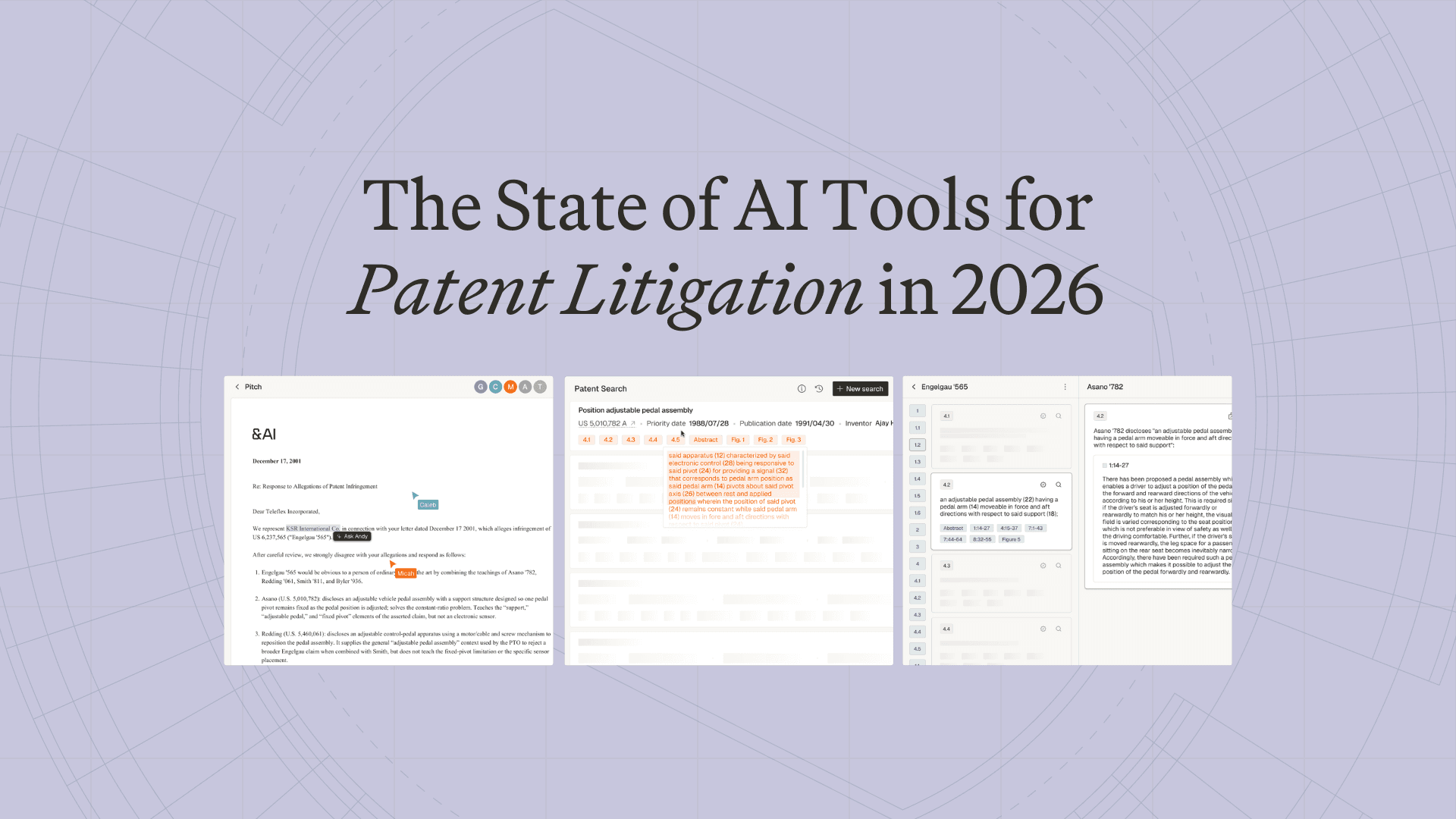
The State of AI for Post-Grant and Patent Litigation in 2026
What separates trial-ready AI from prosecution add-ons, and why &AI is the best tool for patent litigators.
February 1, 2026
How to Evaluate AI for Patent Work
Here's a patent-specific AI evaluation framework covering workflow selection, accuracy measurement, ROI calculation, and vendor alignment.
February 17, 2026

Scale your
patent expertise
&AI is a platform for patent litigators to craft trial-ready work product—fast enough for pitches, strong enough for court.