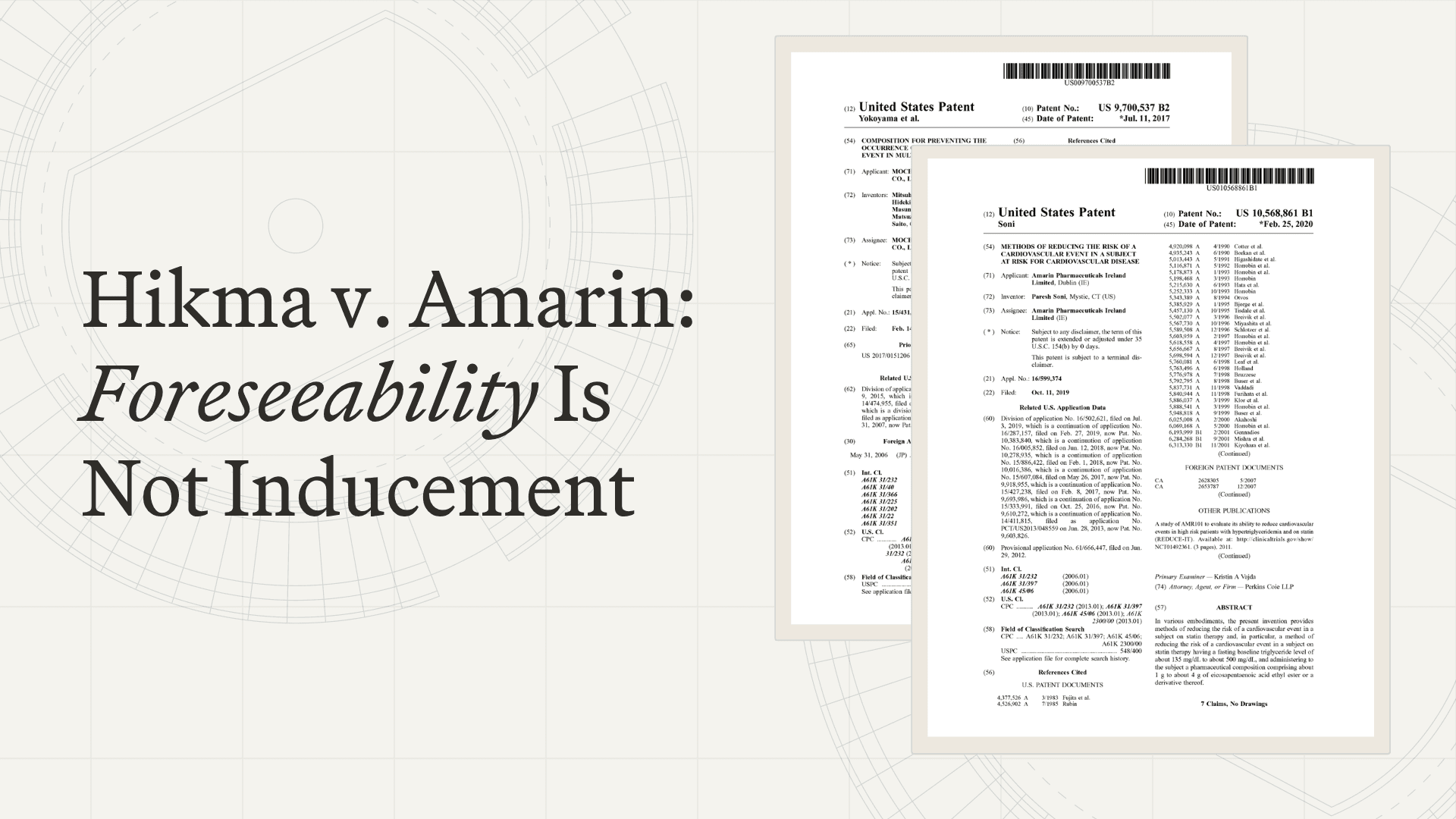
Hikma v. Amarin: Foreseeing Infringing Use Isn't Induced Infringement
June 20, 2026
Caleb HarrisIn Hikma Pharmaceuticals USA Inc. v. Amarin Pharma, Inc. (No. 24-889, decided June 4, 2026), a unanimous Supreme Court held that Amarin failed to plausibly plead a claim for induced infringement under 35 U.S.C. §271(b) on the allegations it pleaded. A generic drugmaker does not actively induce infringement merely because it can foresee that doctors will prescribe its product for a patented use. To state a claim, the patent owner must allege affirmative "active steps" designed to encourage the infringing use. Because Amarin alleged no such steps, the Court held that its complaint could not survive Hikma's Rule 12(b)(6) motion to dismiss, and it reversed and remanded the Federal Circuit's contrary decision. Justice Jackson wrote for the Court.
The ruling came at the pleading stage, on a motion to dismiss, and it is an important win for generic manufacturers that rely on "skinny labels."
What did Hikma v. Amarin decide?
Amarin makes Vascepa (icosapent ethyl). It holds method-of-use patents covering one indication, reducing cardiovascular risk in hypertriglyceridemia patients already taking statins (the "CV indication"), but not the older indication for severe hypertriglyceridemia (the "SH indication"). Hikma launched a generic after supplementing its ANDA with a Hatch-Waxman section viii statement, representing that it sought approval only for the unpatented SH use, and using a "skinny label" that carved out the still-patented CV method of use. (FDA approval and patent infringement are separate questions; the FDA does not adjudicate infringement.)
Amarin sued, arguing that the totality of Hikma's statements (the label, the patient leaflet, its website, and investor press releases) actively induced doctors to use the generic for the patented CV indication. Amarin's theory did not rest on the skinny label in isolation, but on those materials taken together. The district court dismissed the complaint. The Federal Circuit revived it, accepting that it was "at least plausible that a physician could read" those statements as encouragement to infringe. The Supreme Court reversed and rejected that framing: the central question is whether the defendant actively encouraged infringement, not whether a doctor could read its statements as encouragement.
Foreseeability and "active steps" under §271(b)
Induced infringement has three elements: direct infringement by a third party; knowledge that the induced acts infringe; and "active steps… to encourage direct infringement." For purposes of Supreme Court review, Hikma did not challenge the sufficiency of Amarin's allegations on direct infringement or on Hikma's knowledge and specific intent; the dispute centered on whether Hikma took active steps to encourage infringement.
"Active steps," the Court explained, means "affirmative," not passive, conduct: "purposeful, culpable expression and conduct" "designed to stimulate others to commit" infringement. Statements that could be read as encouragement are a broader and different category from statements designed to encourage. And "ordinary acts incident to product distribution" don't count. Generic makers, the Court acknowledged, surely know (and may even expect) that their drugs will be substituted for patented uses. But "mere knowledge of infringing potential or of actual infringing uses" has never been enough. At the same time, the Court rejected Hikma's argument that inducement must be express: implicit encouragement can suffice, so long as it is affirmative and clear to the relevant audience.
That is the line the decision draws. Knowing, or even expecting, that infringement will follow is not inducing it. Inducement requires knowledge of the infringement plus an affirmative act aimed at bringing it about, not merely predictable downstream prescribing or substitution. The Court focused on whether Hikma's pleaded statements and conduct objectively amounted to affirmative encouragement of the patented use, rather than whether infringement was foreseeable or whether Hikma subjectively hoped for generic substitution.
Why Amarin's allegations fell short
The Court worked through Amarin's evidence and found each piece wanting.
Compliance isn't encouragement. Hikma's skinny label carved out the CV indication while retaining certain information from Vascepa's label, because generic labels generally must match the brand label except for permissible carve-outs. Truthfully describing the product as a "generic equivalent" of the brand comparator is "normal industry practice." The Court declined to turn compliance and industry standards into "building blocks for illegal conduct," though misleading, promotional, or broader-than-label statements could still be actionable.
Omissions don't count. Amarin could not build inducement out of what Hikma's label and press releases left out, since §271(b) looks for affirmative acts, not "mere omissions, inactions, or nonfeasance."
Vague plus speculative isn't plausible. A leaflet side-effect warning, an "AB" therapeutic-equivalence rating, a broad therapeutic category, and investor sales figures all required a speculative chain of inferences to reach infringement. Under ordinary pleading standards, that is "a sheer possibility," not a plausible claim.
What it means
For generic manufacturers, the decision is helpful but not an absolute shield: it does not hold that skinny labels categorically defeat inducement, only that these allegations did not plausibly show affirmative encouragement. A compliant skinny label and standard, legally required labeling, without more, do not plausibly allege inducement. Crucially, the ruling narrows the pleading path, not the patent: the Court left method-of-use patents on later-developed indications fully enforceable and preserved inducement as a real remedy. For patent owners, it raises the practical pleading bar for skinny-label inducement theories. An inducement theory built on "they knew doctors would do it anyway," or on how a physician might read neutral statements, will not survive a motion to dismiss. But where a generic pairs routine, compliant language with affirmative messaging that steers prescribers toward the patented use, an inducement claim remains available. The Court also pushed back on a recent Federal Circuit trend of asking how others might read a defendant's statements rather than what the defendant actively did.
Frequently asked questions
What did the Supreme Court hold in Hikma v. Amarin?
The Court held that Amarin failed to plausibly plead a §271(b) induced-infringement claim. Foreseeing that doctors will use a generic drug for a patented use does not, by itself, amount to inducement; a patent owner must plausibly allege that the defendant took affirmative "active steps" designed to encourage the infringing use. The Court, unanimous, in an opinion by Justice Jackson on June 4, 2026, held the complaint could not survive Hikma's Rule 12(b)(6) motion to dismiss, and reversed and remanded the Federal Circuit.
Is foreseeability enough to prove induced infringement?
No. The Court reaffirmed that "mere knowledge of infringing potential or of actual infringing uses" is not enough. Inducement under §271(b) requires affirmative conduct designed to encourage infringement, not just awareness that it may occur.
What are the elements of induced infringement under §271(b)?
Three elements: (1) direct infringement by a third party; (2) the inducer's knowledge that the induced acts infringe; and (3) "active steps… to encourage direct infringement." Hikma v. Amarin turned on the third, the "active steps" requirement.
What is a skinny label, and how does Hikma v. Amarin affect it?
A skinny label is a generic drug label that carves out a brand's still-patented method of use under the Hatch-Waxman section viii pathway. Hikma v. Amarin is a helpful skinny-label decision, though not an absolute shield: a label that simply omits the patented use and uses legally required or standard industry language does not, without more, induce infringement.
How do you defend an induced infringement claim after Hikma?
Show that the challenged statements are compliance with legal or industry norms, neutral omissions, or too vague to be affirmative encouragement, and that the plaintiff's theory depends on speculation about how others might act. After Hikma, statements that merely could be read as encouragement are not "active steps."
What is the difference between induced and contributory infringement?
Both are forms of indirect infringement. Induced infringement (§271(b)) targets a party that actively encourages another to infringe; contributory infringement (§271(c)) targets supplying a component especially made for an infringing use with no substantial non-infringing use. Hikma v. Amarin addresses the "active steps" required for the inducement branch.
Related insights
Novo Nordisk Targets Hims & Hers’ Compounded Semaglutide Offerings in Patent Lawsuit
Novo Nordisk's suit against Hims signals a new phase in the fight over compounded GLP-1 drugs.
February 18, 2026
Sound View Innovations, LLC v. Hulu, LLC: Federal Circuit Affirms Noninfringement
The Federal Circuit affirms noninfringement, clarifying implicit step-order requirements in method claims.
February 7, 2026

Scale your
patent expertise
&AI is a platform for patent litigators to craft trial-ready work product—fast enough for pitches, strong enough for court.