Video as Prior Art and Infringement Evidence: A Patent Litigator's Guide
June 16, 2026
&AI TeamYes, a video can materially affect a patent case. A publicly accessible video can qualify as printed-publication prior art that helps invalidate a claim, and video can also be evidence that a product infringes. The existence of the clip is rarely the issue. Deciding whether it is usable in a petition, claim chart, expert report, or trial record is harder: can you authenticate it, can you prove when its content became publicly accessible, and does it actually disclose the limitation in dispute?
One litigator told us the only clear shot they ever got of the infringing element of a product came from a TikTok video. A patent attorney made the same point about search scope: the best invalidity evidence is not always in the USPTO database, it is in product demos, conference footage, teardown videos, archived pages, or products no one thought to preserve. More and more of the evidence that decides patent cases now lives on camera, and for years video was the one corner of discovery you could not really search.
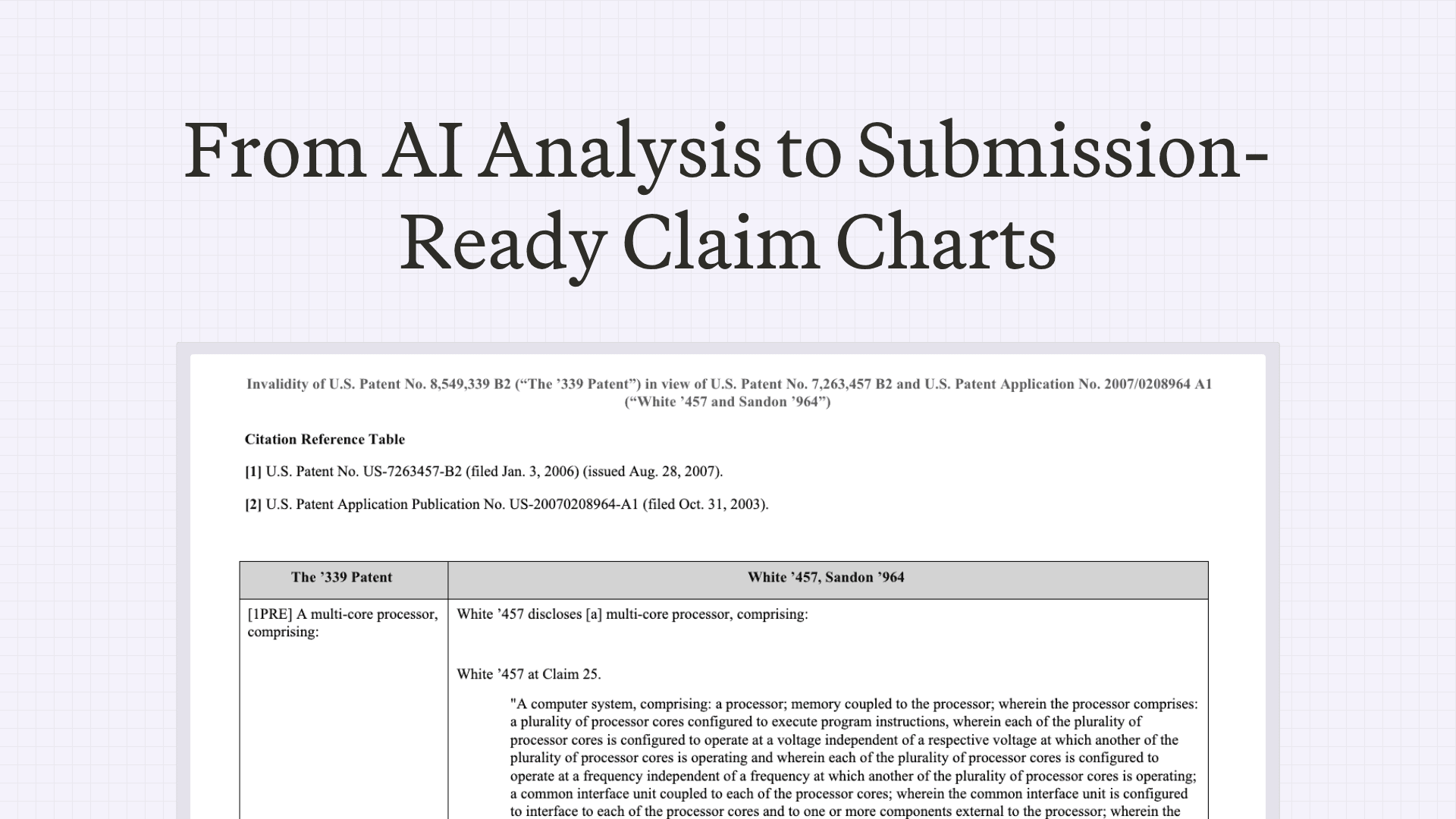
&AI brings video into both search and claim charts, so this kind of evidence is finally easy to find and use. In the &AI platform, you can search supported web and video sources for prior-art and accused-product footage without leaving your matter, alongside prior art search and infringement detection. Upload your own footage or paste a URL, and &AI extracts key frames, transcript text where available, and timestamped segments, with the source kept attached. From there you build draft invalidity and evidence-of-use claim charts that map a frame, timestamp, or transcript segment to a specific limitation. Finding the footage and the exact moment should not be the bottleneck, so your time goes to the legal questions below.

Can a video be prior art?
Yes, but the theory and the forum matter. A video may itself be prior art if it was publicly accessible before the applicable prior-art date and discloses the limitation being asserted. In an IPR, that means the video must qualify as a printed publication, because IPR challenges are limited to grounds under sections 102 and 103 based on patents or printed publications (35 U.S.C. § 311(b)). In district court, or within nine months of grant in a post-grant review, the same footage may also be evidence of public use, on-sale activity, or how a product actually operated.
"Publicly accessible" is a legal test, not just a statement that a URL exists. The question is whether interested, ordinarily skilled people exercising reasonable diligence could have located the video; indexing and searchability can matter, but so can dissemination, audience, privacy restrictions, and how long it was available. The date that matters is when the relied-on content became publicly accessible, not necessarily when it was uploaded, edited, or reposted. Under the AIA that benchmark is generally the patent's effective filing date, subject to the section 102(b) grace period for the inventor's own disclosures, which matters because a company's own product demo can become prior art against its own later patent.
Does the USPTO treat video and social media as prior art?
Yes. MPEP § 2128 states that an electronic publication, "including an online database or Internet publication (e.g., discussion group, forum, digital video, or social media post)," is a printed publication and therefore prior art if it was publicly accessible. The manual names digital video and social media posts specifically, with the caveat that timestamps may need scrutiny.
Have courts and patent offices accepted online and video material as prior art?
Yes in principle, under the same public-accessibility framework, though the video-specific case law is thinner than the framework suggests. U.S. courts have accepted Internet materials as printed publications: Suffolk Techs. v. AOL & Google (Fed. Cir. 2014) involved a newsgroup post, and Blue Calypso v. Groupon framed the test as whether the reference was sufficiently disseminated or otherwise available to the interested public, while also holding that the challenger must actually prove that accessibility. Those are not video cases. No controlling Federal Circuit decision squarely holds that a video is a printed publication, so the theory rests on analogy to these online-materials cases plus USPTO examination guidance, and it remains largely untested at the appellate level. European Patent Office Boards of Appeal have gone further on video specifically, including T 0534/17 (what a video showed at a given timestamp) and T 3000/19, which stressed preserving the video's content and the metadata showing when and how it was made available, because a URL and a screenshot may not be enough if the video later disappears.
The hard part: proving the video, the date, and the disclosure
A clip on its own is rarely enough. Three questions usually decide whether it matters.
First, can you authenticate it? Federal Rule of Evidence 901 asks for evidence sufficient to support a finding that the video is what you say it is, shown through testimony, distinctive characteristics, platform or business records, expert testimony about collection, or stipulation. Federal Rules of Evidence 902(13) and 902(14) can self-authenticate certain certified electronic records or copied data.
Second, can you prove when the relied-on content became publicly accessible? Upload dates and metadata help but can be disputed; stronger evidence includes archive captures, platform records, declarations, collection logs, or hash values. Authentication and public accessibility are distinct questions, and both need an answer.
Third, what does the video actually disclose? It is good only for what the authenticated recording shows, says, captions, or otherwise conveys. In an IPR reported as Cartessa Aesthetics v. Serendia (IPR2022-00594), the petition leaned on a YouTube video plus statements about the depicted device that were not in the video; the PTAB declined to treat those outside statements as printed-publication prior art, and a concurrence noted the video itself, if publicly available, can qualify. That decision is a non-precedential, institution-stage denial that turned largely on claim construction, so treat it as illustrative rather than controlling. The takeaway still holds: rely on the authenticated video, not on later assertions about an unseen device. Treat a transcript as a navigation and citation aid, and preserve the original recording tied to the exact timestamp.
A practical preservation checklist
When you find a potentially important video, capture more than the visible clip: the title, URL, platform, uploader or channel, displayed upload date, access date, the full file where lawful, screenshots of the source page, relevant timestamp ranges, the transcript, captions, the description, and any available metadata. Record who collected it, when, how, and whether the file was hashed. If the video may become central, consider platform records, a custodian declaration, a preservation vendor, or a Rule 902 certification, and do it before the video is edited, deleted, made private, or geo-blocked.
Can video prove infringement?
Yes, but it raises different questions than prior art. Public accessibility is usually not the issue. The questions are whether the footage depicts the accused product, the relevant version and configuration, and the claimed operation during the relevant period, and whether the clip can be authenticated and admitted (including any hearsay or completeness objections). A public demo, teardown, trade-show video, or social post can be powerful evidence that a product practices a claim, and it can anchor an evidence-of-use chart. It often still needs to be paired with source testimony, product records, or expert analysis: a video that shows the product generally may not prove the specific limitation, and one that shows a limitation may leave disputes about version, settings, or whether the accused party made, used, sold, offered, imported, or induced the conduct. A public demo also tends to show capability rather than that the accused instrumentality, as sold and configured, meets every limitation, and method claims raise direct-infringement, inducement, and divided-infringement questions a clip rarely resolves on its own.
Why this matters
The shot from the TikTok can win the case, and a forgotten product demo can kill the claim. A video still has to be authenticated, dated, and shown to disclose the limitation, and winning that fight is your work. What changes with &AI is whether you find the footage early enough to preserve it, chart it, test it with experts, and put it in a petition or contentions while it still counts. When the proof is on video, watching every minute by hand should not be the bottleneck.
Start a free 7-day trial for the whole team with included credits. Create an account to get started right now.
Frequently asked questions
Can a YouTube video be prior art?
Yes. A YouTube video can be prior art if it was publicly accessible before the applicable prior-art date and discloses the claimed invention in a legally sufficient way. In an IPR, the key question is whether the video itself qualifies as a printed publication; in district court, the same video may also be evidence of public use or sale. A public URL or displayed upload date helps but is not always enough, so preserve the video, source page, metadata, and evidence of when and how it was available.
How do you authenticate and date a video used as prior art?
Authentication and public accessibility are distinct. Authentication asks whether the video is what the proponent claims it is. Public accessibility asks whether the relevant public could reach it before the applicable prior-art date. Date evidence may include platform records, archive captures, page metadata, testimony, declarations, or business records. Preserve the file, source page, timestamps, transcript, metadata, and collection history, because a later screenshot of a now-missing URL may not be enough.
What makes a video qualify as prior art?
Two things: public accessibility before the applicable prior-art date, and a legally sufficient disclosure. The video must have been available to the relevant public before the applicable prior-art date, and it is useful only for what the authenticated video actually shows, says, captions, or otherwise conveys.
Does the USPTO consider social media posts as prior art?
Yes, potentially. MPEP § 2128 identifies social media posts as examples of Internet publications that can qualify as printed publications when publicly accessible to people concerned with the relevant art. The MPEP also cautions that not all social-media content is publicly accessible and that timestamps may require scrutiny.
Can video be used as evidence of patent infringement?
Yes. Video can show an accused product performing a claimed step or including a claimed feature. The proponent still needs to prove that the footage depicts the accused product, version, configuration, and use, and that the clip can be authenticated and admitted. For some claims it is powerful direct evidence; for others it is circumstantial evidence paired with source testimony, product records, or expert analysis.
How do you cite a video as prior art?
Identify it with enough detail for the Office, court, or Board to find and evaluate it: title, platform, URL, uploader or channel, publication or upload date, access or capture date, relevant timestamp ranges, and any archive information. In litigation or PTAB practice, preserve the underlying file and source context, and point the citation to the exact moment relied on, not just the top-level URL.
Is there an AI tool that searches patents, non-patent literature, and products at once?
Yes. &AI runs a single search across patents, non-patent literature, and real-world products, including supported video sources such as product demos and teardowns. Keep the forum in mind: an IPR is limited to patents and printed publications, so the video itself must qualify, while district court and, in the right posture, post-grant review can involve broader theories such as public use and on-sale activity. Searching all of these together surfaces prior art a patents-only search would miss.
How do you find prior art to invalidate a patent?
Start with the asserted claim limitations, the likely constructions, and the priority date. Then search beyond patents: technical literature, archived web pages, product documentation, standards, conference materials, and video and social sources. Many online materials, including digital video, can be printed-publication prior art when publicly accessible (MPEP § 2128), while a product in public use raises a separate theory. Capture the date, source, and exact limitation mapping for each candidate. &AI automates this search and pins each hit to its source, including the exact timestamp in a video.
How does &AI help with video prior art and infringement evidence?
&AI searches supported sources for relevant video, accepts uploads or a URL, and extracts key frames, transcript text where available, and timestamped segments. You can then map specific moments into draft invalidity or evidence-of-use charts, with the source kept attached for your authentication workflow.
Related insights

Scale your
patent expertise
&AI is a platform for patent litigators to craft trial-ready work product—fast enough for pitches, strong enough for court.